
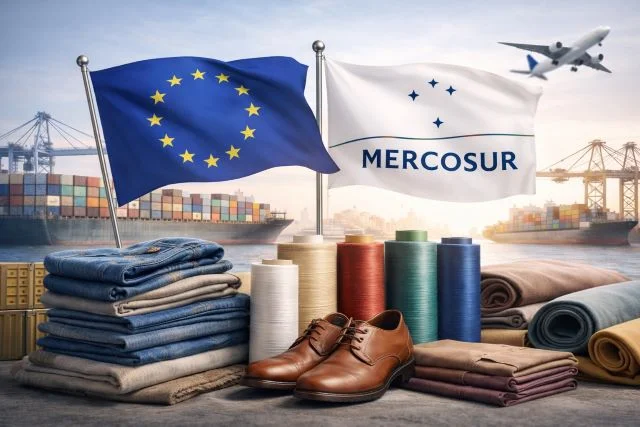
The European Commission’s decision to move forward with the provisional application of the EU-Mercosur trade agreement could significantly reshape trade flows in the global textile, apparel, and fashion industry.
European Commission President Ursula von der Leyen said the bloc would proceed with provisional implementation of the long-negotiated deal after Argentina and Uruguay ratified the agreement, with Brazil and Paraguay expected to follow. Full entry into force will still require the consent of the European Parliament.

For the fashion and textile sector, however, provisional application could unlock tangible commercial effects well before final ratification.
The EU-Mercosur agreement connects a market of more than 700 million people, linking the European Union with Argentina, Brazil, Paraguay and Uruguay. Among the sectors expected to see notable impact are textiles, apparel, footwear and leather goods.
Mercosur countries currently maintain relatively high tariffs on imported clothing and textile products. In some cases, duties range from 14% to 35%, creating significant price barriers for European fashion brands seeking to expand in South America.
Under the agreement, tariffs on a wide range of goods are expected to be gradually reduced or eliminated, improving price competitiveness for European apparel exporters. Luxury brands, mid-market fashion labels and technical textile producers from Italy, Spain, Portugal, Germany and France could benefit from easier access to Mercosur markets.
Industry analysts say the deal could be particularly relevant for premium European fashion houses, which have long viewed Brazil and Argentina as high-potential consumer markets but faced structural tariff obstacles.
At the same time, the agreement may alter sourcing dynamics for European manufacturers.
Brazil is one of the world’s largest cotton producers and a major supplier of leather — two critical raw materials for the global fashion industry. Lower trade barriers could facilitate smoother imports of cotton yarns, fabrics and leather into Europe, potentially improving supply chain efficiency and cost structures.
For footwear and leather goods manufacturers, access to competitively priced raw materials from Mercosur could strengthen production competitiveness, particularly as European companies navigate rising compliance and sustainability costs.
However, the pact also raises concerns within parts of the EU textile and agricultural sectors.
Some European producers fear increased competition from Mercosur-based manufacturers, especially in cotton-based garments and leather products. Differences in labor costs, environmental regulations and production standards remain sensitive issues in political debates surrounding the agreement.
France and several other EU member states have voiced reservations about the broader trade pact, citing environmental concerns linked to deforestation and agricultural production in South America. These concerns are directly relevant to fashion supply chains, particularly in cotton cultivation and cattle-based leather production.
The agreement includes sustainability and environmental provisions, but critics argue that enforcement mechanisms will be crucial.
For the fashion industry, sustainability compliance is no longer optional. The EU’s expanding regulatory framework, including due diligence rules, ESG reporting requirements, and deforestation regulations, means that sourcing from Mercosur countries will require strict traceability and responsible production practices.
Also read: EU’s Carbon Border Adjustment Mechanism Faces Political and Market Scrutiny
As a result, the trade deal could accelerate supply chain transparency initiatives within textile and apparel companies operating between the two regions.
Business associations representing European manufacturers have broadly welcomed the Commission’s move, describing it as a strategic step toward strengthening global value chains at a time of geopolitical fragmentation.
With global fashion brands increasingly diversifying sourcing beyond Asia, South America could emerge as a more integrated partner under the new trade architecture.
The provisional application allows key commercial provisions of the agreement to begin operating before the European Parliament gives its final approval. While legal and political scrutiny continues, companies in the textile and apparel sectors are already assessing how reduced tariffs and simplified trade procedures could influence expansion strategies.
If fully ratified, the EU-Mercosur pact could become one of the most consequential trade agreements for the fashion industry in recent years, affecting everything from cotton sourcing and leather supply to retail pricing and market entry strategies.
As global competition intensifies and sustainability pressures mount, the agreement positions the EU and Mercosur not only as trading partners but as interconnected players in the evolving landscape of textile and fashion supply chains.