
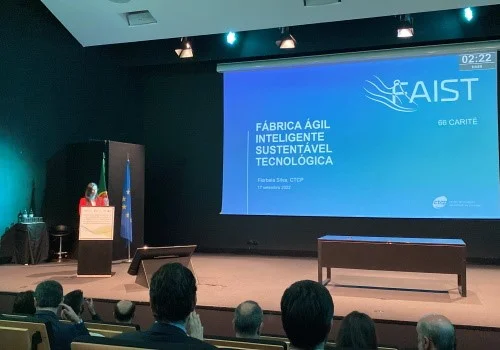
Europe’s clothing and footwear industries are struggling to regain manufacturing ground as global production continues to shift towards Asia, industry and policy leaders said during discussions held under the FAIST Agenda, a European initiative aimed at modernizing the footwear and leather goods sector through technology, sustainability, and smart manufacturing.
The FAIST Agenda is led by the FAIST Consortium, Fábrica Ágil, Inteligente, Sustentável e Tecnológica, and focuses on strengthening competitiveness through Industry 4.0 technologies, circular economy practices, digital product passports, skills development, and regulatory alignment, as Europe faces growing pressure from lower-cost global producers.

The debate, moderated by journalist Estela Machado, brought together representatives from industry associations and the European Commission to examine whether the European Union’s ambition to reindustrialise is translating into tangible outcomes for fashion and footwear manufacturers.
Also Read: French Court Rules Against Shein Website Suspension Over Illicit Product Sales
Kerstin Jorna, Director-General for Internal Market, Industry, Entrepreneurship and SMEs (DG GROW) at the European Commission, described Portugal’s footwear sector as a success story that combines traditional craftsmanship with advanced manufacturing technologies. At the same time, she highlighted the scale of Europe’s decline in global production, noting that European footwear output has fallen from around 30% of global production three decades ago to less than 3% today.
João Maia, representing the Portuguese Footwear, Components and Leather Goods Manufacturers’ Association (APICCAPS), attributed the shift largely to the rapid expansion of Asian manufacturing hubs. He said Europe has increasingly focused on higher value-added activities such as design, branding, and premium footwear, with countries including Portugal, Spain, and Italy preserving specialised skills rather than competing on volume production.
César Araújo of the Portuguese Textile and Apparel Association (ANIVEC) said the commercial landscape for clothing had changed significantly, arguing that European markets remain open to third-country exporters that do not face equivalent regulatory and fiscal obligations. He pointed to ongoing concerns over unpaid customs duties and value-added tax (VAT) as sources of unfair competition for European producers.
Maia added that while the European Commission has announced regulatory reforms aimed at addressing such imbalances, these measures are not expected to come into force before 2028. On the prospects for reindustrialization, he said a slowdown in Chinese exports could encourage production to move closer to consumer markets, but current trends still show factories opening in more cost-competitive Asian countries.
Araújo said Europe’s industrial future would depend on shifting towards higher value-added products within a circular economy, but only if regulatory and legislative requirements such as chemical compliance rules and the forthcoming Digital Product Passport are applied equally to European producers and companies exporting to the EU.
Speakers agreed that Europe’s long-term competitiveness in clothing and footwear would rely on more balanced and agile regulation, combined with strong sustainability frameworks. They concluded that closer coordination between industry and policymakers would be critical to ensure the sector can influence future trade, sustainability and industrial policy decisions.
For major global apparel producers such as Bangladesh, which continues to dominate garment manufacturing through scale and cost efficiency, the discussions underline the widening gap between Europe’s strategy of value-driven, regulation-led manufacturing and Asia’s volume-based production model.