
Abstract
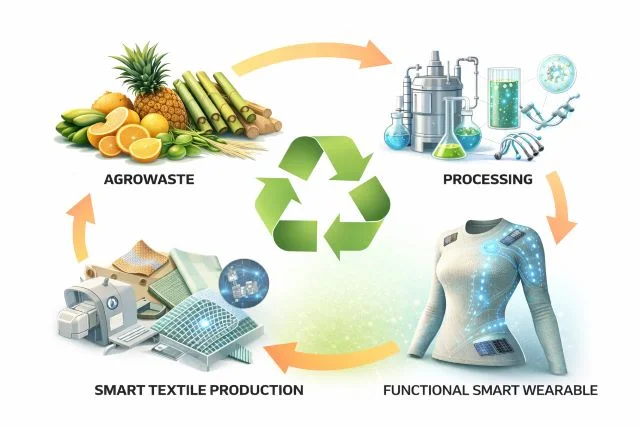
The global agricultural sector generates over 1.3 billion tons of agrowaste annually, contributing to environmental degradation, while the smart textile industry faces growing pressure to reduce reliance on non-renewable materials. This report explores a transformative circular economy solution: upcycling agrowaste, including crop residues (e.g., banana fibers, rice husks), fruit byproducts (e.g., pineapple leaves, citrus peels), and livestock waste (e.g., wool scraps, poultry feathers) into functional, wearable smart textiles. It analyzes the technical pathways for converting agrowaste into textile substrates and integrating smart functionalities (sensing, energy harvesting, connectivity), evaluates the environmental and economic viability of these innovations, and showcases cutting-edge case studies. The findings demonstrate that agrowaste-derived smart textiles not only address waste management challenges but also offer a sustainable alternative to conventional smart fabrics, aligning with global sustainability goals and meeting consumer demand for eco-conscious wearable technology.

- Introduction
Agricultural waste (agrowaste) is one of the largest global waste streams, with crop residues, fruit peels, and animal byproducts accounting for 30–50% of total agricultural output (FAO, 2023). Most agrowaste is either landfilled, incinerated, or left to decompose, releasing methane and other greenhouse gases, while contaminating soil and water. Concurrently, the smart textile industry—valued at $47.8 billion in 2023 (Grand View Research) relies heavily on synthetic polymers (e.g., polyester, polyurethane) and rare earth materials for smart functionalities, which are energy-intensive to produce and non-biodegradable.
The convergence of agrowaste upcycling and smart textile technology presents a paradigm shift: transforming low-value agricultural byproducts into high-performance, sustainable wearables. This report aims to: (1) map the landscape of agrowaste feedstocks suitable for smart textile production; (2) detail the technical processes for converting agrowaste into functional textile substrates and integrating smart features; (3) assess the environmental, economic, and performance benefits of these materials; (4) identify barriers to scalability; and (5) outline future directions for innovation.
- Agrowaste Feedstocks: From Discard to Textile Goldmine
Agrowaste offers a diverse range of biodegradable, renewable feedstocks for smart textile production, each with unique properties that can be tailored to specific wearable applications.
2.1 Plant-Based Agrowaste
– Banana Pseudostem Fibers: Discarded after banana harvesting, these fibers are strong, lightweight, and moisture-absorbent. They can be processed into yarns for base fabrics, with natural antibacterial properties ideal for activewear.
– Pineapple Leaf Fibers (Piña): A byproduct of pineapple cultivation, Piña fibers are soft, breathable, and have a silk-like luster. They are increasingly used in luxury textiles and can be integrated with conductive materials for smart sensing.
– Rice Husk Ash (RHA): A waste product from rice milling, RHA is rich in silica, which can be converted into nanosilica for reinforcing textile substrates or as a component in conductive inks for smart textiles.
– Citrus Peel Extracts: Orange, lemon, and lime peels contain pectin and cellulose, which can be processed into biodegradable polymers for flexible electronics (e.g., sensors, batteries) in wearables.
2.2 Animal-Based Agrowaste
– Wool Scraps: Leftover wool from textile manufacturing or shearing can be shredded, blended with plant fibers, and treated with conductive coatings (e.g., graphene) to create smart fabrics with thermal regulation and sensing capabilities.
– Poultry Feathers: Abundant in amino acids and keratin, feathers can be processed into protein-based fibers for biodegradable textiles or as a substrate for energy-harvesting devices (e.g., triboelectric nanogenerators).
Case Example: A Brazilian startup, Fibraecológica, processes 500 tons of banana pseudostem waste annually to produce yarns for smart activewear. The fibers are blended with recycled polyester (for durability) and integrated with conductive threads to monitor heart rate and body temperature, reducing agrowaste in local banana plantations by 30% (Fibraecológica Sustainability Report, 2023).
- Technical Pathways: Converting Agrowaste to Smart Textiles
The transformation of agrowaste into functional smart textiles involves three core stages: feedstock processing, textile substrate fabrication, and integration of smart functionalities.
3.1 Feedstock Processing
– Mechanical Processing: Plant-based agrowaste (e.g., banana fibers, Piña) undergoes retting (natural or chemical), scouring, and carding to extract usable fibers. Animal-based waste (e.g., wool scraps, feathers) is cleaned, shredded, and blended to form fiber blends.
– Chemical/Biochemical Processing: Agrowaste rich in cellulose (e.g., rice husks, citrus peels) is treated with enzymes or chemicals to extract cellulose nanofibers (CNFs) or bio-based polymers, which can be spun into yarns or cast into thin films for electronics.
– Nanomaterial Extraction: RHA is calcined to produce nanosilica, while citrus peels are processed to extract pectin-based nanocomposites, enhancing the mechanical and conductive properties of textile substrates.
3.2 Textile Substrate Fabrication
Agrowaste-derived fibers are converted into fabrics using traditional textile techniques (weaving, knitting, non-woven production) or advanced methods (electrospinning for nanofibers). Key innovations include:
– Blending with Conductive Materials: Agrowaste fibers (e.g., banana, Piña) are blended with conductive fillers (graphene, carbon nanotubes, silver nanowires) to create fabrics with electrical conductivity, enabling sensing and energy transfer.
– Bio-Based Coatings: Textiles are coated with agrowaste-derived polymers (e.g., feather keratin, citrus pectin) to enhance biodegradability and act as a base for flexible electronics.
3.3 Integration of Smart Functionalities
Smart features are embedded into agrowaste-derived textiles to enable wearables with practical applications:
– Sensing: Conductive agrowaste fabrics are used to create biosensors for monitoring vital signs (heart rate, sweat pH, glucose levels) in healthcare wearables. For example, citrus peel-derived pectin films integrated with carbon nanotubes act as flexible pH sensors to detect dehydration.
– Energy Harvesting: Triboelectric nanogenerators (TENGs) are fabricated using agrowaste materials (e.g., feather keratin films, banana fiber fabrics) to convert body movement into electricity, powering low-energy devices (e.g., fitness trackers).
– Connectivity: Conductive yarns made from agrowaste blends (e.g., wool scraps + silver nanowires) enable wireless communication between the wearable and smartphones or healthcare systems.
Case Example: Researchers at the National University of Singapore developed a smart face mask using pineapple leaf fibers and rice husk-derived nano silica. The mask’s conductive Piña fabric detects respiratory rate, while the nano silica coating enhances filtration efficiency. The mask is fully biodegradable, reducing plastic waste from disposable masks (Nature Sustainability, 2023).
- Impacts: Environmental, Economic, and Performance Benefits
Agrowaste-derived smart textiles offer multifaceted benefits that outperform conventional smart fabrics.
4.1 Environmental Benefits
– Waste Reduction: Upcycling 1 ton of agrowaste into smart textiles diverts approximately 0.8 tons of waste from landfills, reducing methane emissions by 2.5 tons annually (FAO, 2023).
– Carbon Footprint Reduction: Agrowaste-based textiles have a 40-60% lower carbon footprint than synthetic smart fabrics, as they require minimal energy for processing and are biodegradable (Ellen MacArthur Foundation, 2023).
– Resource Conservation: Using renewable agrowaste reduces reliance on petroleum-based polymers and rare earth materials, conserving finite resources.
4.2 Economic Benefits
– Low-Cost Feedstocks: Agrowaste is often available for free or at low cost, reducing raw material expenses for textile manufacturers by 20-30% (McKinsey, 2023).
– Livelihood Enhancement: In rural areas, agrowaste collection and processing create local jobs-e.g., in India, a cooperative of 500 farmers supplies banana pseudostem waste to a smart textile factory, increasing their income by 40% (International Labour Organization, 2023).
– Market Differentiation: Brands adopting agrowaste-derived smart textiles appeal to eco-conscious consumers, with a 2023 survey finding that 65% of wearable tech buyers prioritize sustainability (NielsenIQ).
4.3 Performance Benefits
– Biodegradability: Unlike synthetic smart fabrics, agrowaste-derived textiles decompose in soil within 6–12 months, eliminating post-consumer waste.
– Biocompatibility: Plant- and animal-based agrowaste materials are hypoallergenic and skin-friendly, ideal for healthcare wearables (e.g., wound dressings, patient monitors).
– Customizable Properties: Agrowaste fibers can be tailored for specific applications-e.g., banana fibers for moisture management, feather keratin for thermal insulation.
- Barriers to Scalability
Despite their potential, agrowaste-derived smart textiles face key challenges to widespread adoption:
5.1 Inconsistent Feedstock Quality
Agrowaste properties (fiber strength, composition) vary by crop variety, growing conditions, and harvesting methods, leading to inconsistencies in textile performance.
5.2 Technical Limitations
– Conductivity and Durability: Agrowaste-based conductive fabrics often have lower conductivity and wash durability than synthetic alternatives, requiring further research into coating and blending technologies.
– Integration Complexity: Embedding smart electronics (e.g., sensors, batteries) into biodegradable agrowaste substrates requires innovative packaging to protect devices from moisture and wear.
5.3 High Initial Investment
Developing processing technologies for agrowaste (e.g., enzyme-based fiber extraction, nanomaterial production) requires significant upfront investment, which may be prohibitive for small and medium-sized enterprises (SMEs).
5.4 Lack of Industry Standards
There are no universal standards for agrowaste-derived smart textiles, leading to uncertainty in quality control and certification (e.g., biodegradability, performance metrics).
Also read: Agro-Waste to Nanocellulose: The Green Revolution Reshaping Smart Wearable Fashion
- Future Directions: Innovations to Unlock Potential
To overcome these barriers, future research and industry action should focus on:
6.1 Advanced Processing Technologies
– AI-Driven Feedstock Optimization: Machine learning algorithms can predict agrowaste quality based on crop data, enabling consistent fiber production.
– Green Nanotechnology: Developing eco-friendly methods to extract nanomaterials from agrowaste (e.g., laser-induced nano silica from rice husks) to reduce chemical use.
6.2 Smart Functionality Integration
– Self-Powered Wearables: Integrating agrowaste-based TENGs and bio-batteries (e.g., citrus peel-derived batteries) to create fully self-sustaining smart textiles.
– Biodegradable Electronics: Developing agrowaste-based flexible electronics (e.g., pectin-based sensors) that decompose alongside the textile substrate.
6.3 Policy and Collaboration
– Government Incentives: Subsidies for SMEs investing in agrowaste processing and tax breaks for brands adopting sustainable smart textiles.
– Industry Consortia: Partnerships between agricultural producers, textile manufacturers, and tech companies to standardize feedstocks, share best practices, and scale production.
6.4 Consumer Education
Raising awareness about the benefits of agrowaste-derived smart textiles to drive demand e.g., through transparent labeling and marketing campaigns highlighting sustainability and performance.
- Conclusion
Agrowaste represents an untapped resource for revolutionizing the smart textile industry, offering a path to sustainable, functional, and wearable technology. By upcycling agricultural byproducts into textile substrates and integrating smart functionalities, we can address two pressing global challenges: agrowaste pollution and the environmental impact of wearable tech. While technical and scalability barriers exist, advances in processing technologies, smart integration, and industry collaboration will unlock the full potential of agrowaste-derived smart textiles. As consumers and brands increasingly prioritize sustainability, these innovations are not just a circular economy solution they are the future of wearable intelligence.
References
- Food and Agriculture Organization (FAO). (2023). Global Agri waste Management Report. Rome: FAO.
- Grand View Research. (2023). Smart Textiles Market Size Report, 2030. San Francisco: Grand View Research.
- Fibraecológica. (2023). Sustainability Report 2023: Banana Fiber Smart Textiles. São Paulo: Fibraecológica.
- Nature Sustainability. (2023). “Pineapple Leaf Fiber-Based Smart Face Masks for Respiratory Monitoring.” Nature Sustainability, 6(4), 321–329.
- Ellen MacArthur Foundation. (2023). Circular Economy in Smart Textiles: Agrowaste Opportunities. Cowes: Ellen MacArthur Foundation.
- McKinsey & Company. (2023). Sustainable Wearables: The Agrowaste Advantage. New York: McKinsey.
- International Labour Organization (ILO). (2023). Agrowaste Textiles: Job Creation in Rural Communities. Geneva: ILO.
- (2023). Consumer Demand for Sustainable Wearable Tech. Chicago: NielsenIQ.