
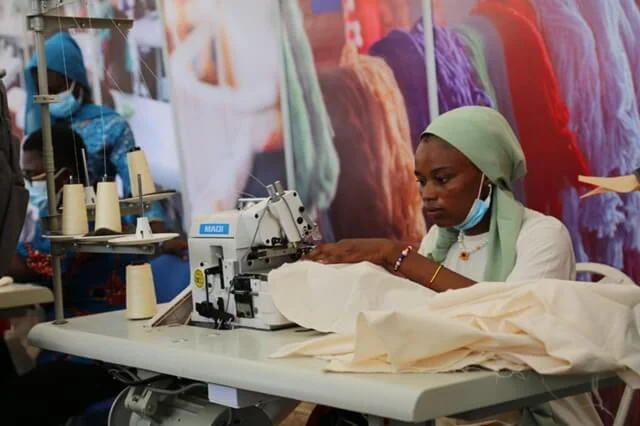
Ghana’s government is stepping up efforts to deepen job creation and industrial growth by expanding support for the garment and textile manufacturing sector, with plans to establish three major garment factories in collaboration with the private sector this year.
Trade, Agribusiness and Industry Minister Elizabeth Ofosu-Adjare said the initiative aims to broaden export-oriented industries beyond traditional sectors such as cocoa and minerals, while generating employment across multiple skill levels — from university graduates to workers with limited formal education.

Under the proposed plan, major garment production facilities will be located in the Central, Bono East, and Eastern Regions, collectively expected to employ around 27,000 people.
The government has positioned the private sector as the lead investor and operator of these facilities, with the state providing an enabling environment through policy support, incentives, and capacity-building measures.
Officials stress that the garment sector can absorb large numbers of workers with relatively short training periods — many roles require just weeks of training before workers become fully operational.
Also Read : Cone Denim Marks 1 Million Safe Hours at Parras Mill
In addition to job creation, the strategy is designed to expand export capacity, tapping into regional and global markets. Ghana’s geographic advantage and duty-free access under trade agreements such as the African Continental Free Trade Area (AfCFTA) are expected to support export-oriented growth.
Policy frameworks such as the country’s 24-Hour Economy initiative also identify textile and garment value chains as key components of Ghana’s industrial transformation, with plans to support both large-scale factories and small and medium enterprises (SMEs) in the sector through capacity building, finance access, and formalization support.
The garment expansion is part of a wider national push to boost manufacturing under Ghana’s industrialization agenda, which targets new investments, higher exports, and broader value chain development.
The government has recently engaged with international development partners, such as the United Nations Industrial Development Organization (UNIDO), to support industrial projects and sustainable growth.
Industry observers say that scaling up textile and garment production could position Ghana as a competitive manufacturing hub in West Africa, leveraging lower labour costs and proximity to key export markets in Europe and North America.
Implementation timelines, investor commitments, and export contracts will be key factors determining how quickly these plans translate into production and income for Ghana’s workforce and economy.