
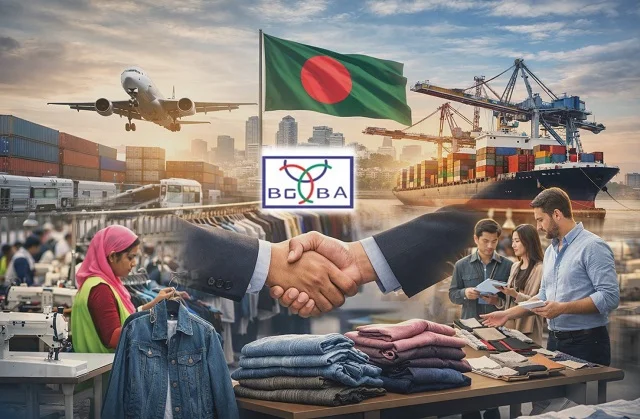
Bangladesh’s ready-made garment (RMG) industry is one of the world’s largest, supplying global brands across major markets. While attention often centers on factories, workers, and export earnings, a less visible but equally critical group shapes the sector’s global reach: garment buying houses. At the heart of this network is the Bangladesh Garment Buying House Association (BGBA), which has evolved from a representative platform into a key institution strengthening trust, market access, and professional standards across Bangladesh’s garment supply chain.
BGBA began in 2002 as an informal platform bringing garment buying houses together under one umbrella. Its primary objective was to enable collaboration, knowledge sharing, and unified representation. Over the years, BGBA has supported buying houses in expanding international trade by arranging overseas brand promotions, exploring new markets, and assisting throughout the export process—from initial buyer engagement to final shipment. Through these efforts, BGBA has played a significant role in strengthening Bangladesh’s reputation as a reliable source of quality garments in the global market.


BGBA founding President Qayum Reza Chowdhury explained, “Buying houses exist to do something that factories could not do in the beginning, which is marketing Bangladesh to the world, securing orders, and feeding the garment industry with sustainable business.”
Mr. Reza recalled that after years of uncertainty and resistance regarding the role of buying houses, BGBA was formed following a High Court directive. From the outset, the association emphasized accountability, transparency, and market discipline. All buying houses—local or foreign—were required to register, comply with regulations, and operate responsibly.
Looking ahead, Mr. Reza envisions an even greater role for buying houses. He believes they could eventually act as merchant exporters, directly exporting garments to selected markets under transparent and well-regulated systems. While current trade rules do not fully permit this, he remains confident that future policy reforms could unlock new growth opportunities.
BGBA’s market advantage extends beyond order placement. The association actively participates in international trade fairs, promotes Bangladesh’s manufacturing capabilities, and coordinates with members to meet buyer expectations. This proactive engagement reassures global buyers that Bangladesh is not only a manufacturing hub but also a reliable partner capable of delivering compliance, quality, and timeliness.
Also Read: Bangladesh Sets Global Record in Green Manufacturing in 2025

In its early years, the buying house sector faced challenges due to limited formal recognition and the absence of standardized operational guidelines. BGBA addressed these gaps by engaging with textile industry stakeholders and policymakers to establish frameworks for registration, certification, and operational standards. The association also advocates for mandatory BGBA certification to ensure credibility, transparency, and professionalism across the industry.
BGBA President Md. Mofazzal Hossain Pavel highlighted this transformation, “The role of BGBA has evolved from representation to regulation and facilitation. We are creating an ecosystem where global buyers increasingly prefer to source through professional buying houses by standardizing practices and engaging with policymakers.”
BGBA also works to protect its members from unregistered and informal operators whose irresponsible practices can damage the industry’s reputation. In doing so, the association safeguards both member interests and Bangladesh’s standing in the global apparel market.
BGBA’s Role in Compliance and Sustainability
As international buyers place growing emphasis on environmental and social compliance, BGBA members play a critical role in guiding factories toward meeting these standards. Buying houses oversee production from raw materials to final shipment, ensuring adherence to ESG requirements and buyer-specific compliance expectations.
Also Read: From Lab Bench to Mill Floor: How Fiber Innovation Truly Scales
Vice Presidential candidate and former Chairman of BGBA’s Arbitration Committee, Enamul Kabir, elaborated on these challenges, “Buyer preferences should not fragment compliance. Bangladesh needs a unified, government-led compliance framework that reduces duplication, lowers costs, and protects both factories and buying houses.”

He noted that multiple buyer-specific certifications increase costs without always delivering better outcomes. Instead, he advocates for a single, government-approved compliance system—similar to those in competing sourcing countries. Without coordination, compliance risks becoming a financial burden rather than a tool for meaningful improvement.
Through workshops, capacity-building initiatives, and policy advocacy, BGBA strengthens member awareness of social compliance, ethical sourcing, and responsible supply-chain management. These efforts enhance buyer confidence and contribute to the sector’s long-term sustainability.
Mr. Kabir also emphasized that the true role of buying houses is often underestimated. Beyond logistics, they create new markets by investing in design, identifying buyers in emerging destinations, and building long-term relationships—sometimes absorbing losses before achieving profitability. In this sense, buying houses act as long-term investors in Bangladesh’s export growth.
BGBA’s Leadership and Member-Driven Governance
As global sourcing evolves and compliance requirements tighten, Bangladesh’s ambition to reach USD 100 billion in exports will require a more organized, professional, and globally connected buying house network. Against this backdrop, BGBA’s upcoming election for the 2026–2028 term marks a critical juncture for the association.
The BGBA Election, scheduled for 10 January, reflects the association’s commitment to participatory governance, transparency, and active member participation. The current President, Muzzamal Hossin Pavel, assumed leadership after Mr. Kazi Iffakar Hossin, whose tenure saw notable improvements in member engagement and sector development.
Two panels are contesting the presidency: the United Forum, led by Mr. Mofuz Ullah Bablu, and the Visionary Alliance, led by Mr. Abdul Hamid Pintu. Both leaders are widely respected for their experience and deep industry knowledge. Notably, the Buyer Council is not participating in this election, underscoring the evolving leadership dynamics within BGBA.
This election goes beyond leadership selection. It will shape the association’s strategy for the coming years. Key issues include improving member services, resolving disputes, building buyer confidence, and promoting sustainable growth.
As Mr. Reza observed, “BGBA’s engagement with policymakers, members, and stakeholders ensures that elections are more than a procedural exercise; they are a platform to define the association’s future and strengthen Bangladesh’s RMG sector.”
BGBA has also established strategic partnerships to support its members. Financial collaborations with institutions such as United Commercial Bank (UCB) and Air8 enable small and medium enterprises to access tech-enabled export financing. Partnerships with Eurofins Consumer Product Testing provide affordable solutions for meeting international quality and safety standards. In manufacturing, joint arbitration committees with the Bangladesh Knitwear Manufacturers and Exporters Association (BKMEA) help resolve disputes and advocate for improved policy frameworks.