
Introduction to ReTuna Återbruksgalleria
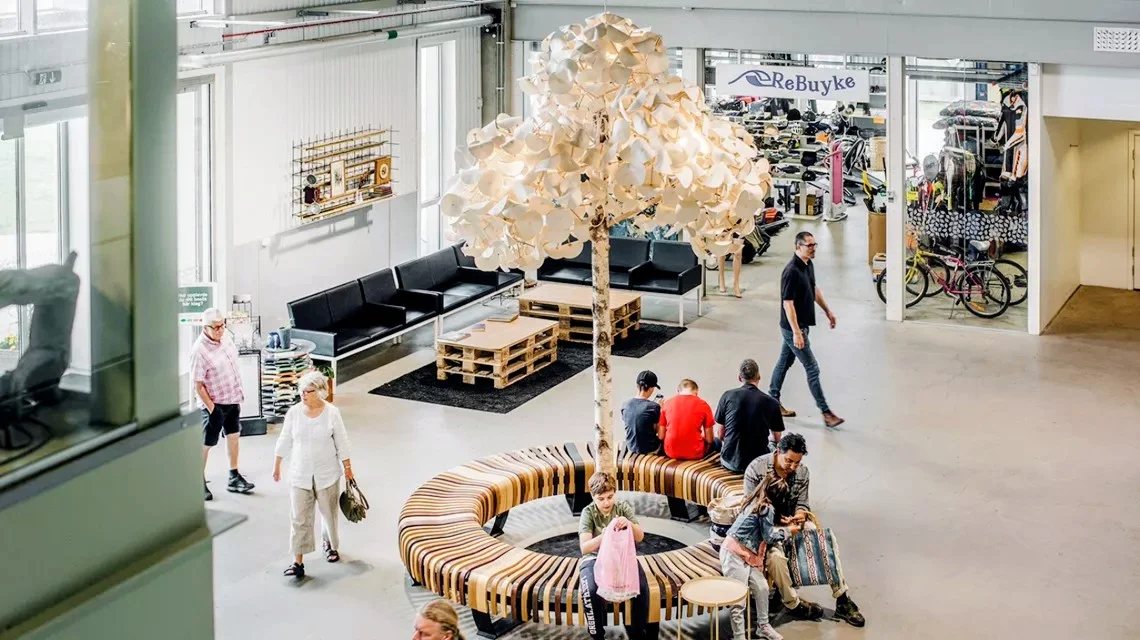
ReTuna Återbruksgalleria, located in Eskilstuna, Sweden, is widely recognized as the world’s first recycling mall, a groundbreaking concept that has transformed the global conversation on circular economy and sustainable retail. Opened in 2015, ReTuna is not just a shopping destination but a working model of how waste can be turned into valuable resources while creating jobs, supporting local businesses, and reducing environmental impact.

How the world’s first recycling mall works
Unlike traditional shopping centers, ReTuna Återbruksgalleria is directly connected to a recycling center. Residents and businesses drop off items they no longer need, such as furniture, clothing, electronics, books, sports gear, and household goods. These items are then sorted and distributed to on-site shops, where they are repaired, redesigned, or creatively upcycled before being sold again.
This closed-loop system significantly reduces waste sent to landfills while extending the lifecycle of products. It also encourages consumers to rethink consumption habits by choosing reuse over buying new.
A global benchmark for circular economy
ReTuna has become a global case study in circular economy practices. By combining retail, recycling, education, and innovation under one roof, the mall demonstrates how cities can integrate sustainability into everyday life. The concept aligns closely with Sweden’s national environmental goals and the European Union’s broader sustainability agenda.
For policymakers, urban planners, and sustainability advocates worldwide, ReTuna offers a scalable model that can be adapted to different cultural and economic contexts.
Retail experience with a sustainable purpose
The mall hosts a range of specialized shops, each focusing on a specific category such as fashion, home décor, electronics, bicycles, and children’s products. Every item sold has been reused, repaired, or redesigned, making sustainability the core value proposition rather than a marketing add-on.
Customers are drawn not only by the environmental benefits but also by the uniqueness of products. Many items are one-of-a-kind, giving shoppers an alternative to mass-produced goods while supporting local entrepreneurs and artisans.
Education, innovation, and community engagement
ReTuna Återbruksgalleria goes beyond retail by serving as an educational hub. The facility includes training spaces, exhibition areas, and collaborations with schools, universities, and sustainability organizations. Workshops on repair skills, upcycling, and conscious consumption are regularly organized to build long-term behavioral change.
Innovation is another key pillar. Designers and startups use ReTuna as a testing ground for new business models based on reuse, repair, and resource efficiency.
Economic and environmental impact
The recycling mall has created green jobs in retail, logistics, repair, and design while supporting small and medium-sized enterprises. Environmentally, ReTuna contributes to reduced carbon emissions by lowering demand for new production and minimizing waste.
The success of the mall proves that sustainability and profitability can coexist. It also highlights how local governments can play a catalytic role by investing in infrastructure that supports circular business ecosystems.
Why ReTuna matters in a changing global retail landscape
As consumers worldwide become more conscious of climate change, waste, and overconsumption, concepts like ReTuna Återbruksgalleria are gaining relevance. Traditional retail models based on constant production and disposal are increasingly questioned, opening space for reuse-based alternatives.
ReTuna’s success sends a strong message to retailers, brands, and cities: the future of retail lies in responsibility, creativity, and collaboration across the value chain.
Conclusion
ReTuna Återbruksgalleria stands as a powerful example of how innovative thinking can redefine shopping, waste management, and community engagement. As the world’s first recycling mall, it has set a new standard for sustainable retail and inspired similar initiatives across Europe and beyond. In an era where sustainability is no longer optional, ReTuna proves that rethinking waste can unlock economic, social, and environmental value on a global scale.
Also Read: Bangladesh Pushes Circular Fashion as Textile Waste Becomes Economic Asset