
Bangladesh is widely known as a global hub for apparel manufacturing. For decades, the country’s textile and garment industry has driven export growth and employment. However, global trends are shifting. Buyers, investors, and policymakers are now focusing on technical and medical textiles, where value addition is higher and long-term growth is more stable. One promising but still underexplored area for Bangladesh is medical stents.
What Are Stents and Why Are They Important?

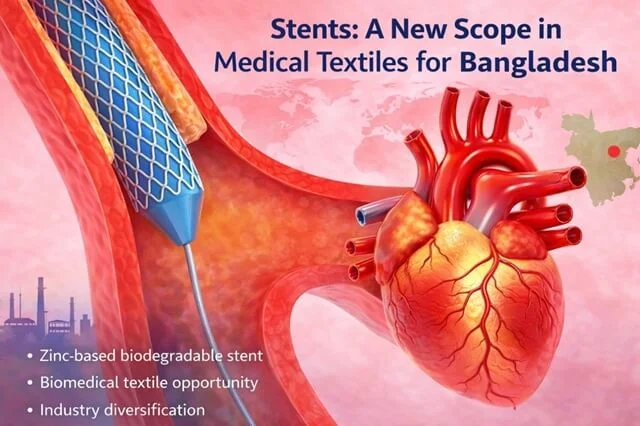
Stents are small tube-like medical devices. Doctors insert them into narrowed or blocked blood vessels to keep the vessel open. They are mainly used in cardiovascular treatments, especially for heart disease. Millions of stent procedures are performed globally every year.
Most stents used today are made from metals and remain permanently inside the body. While effective, permanent stents can cause long-term issues such as inflammation, blood clot formation, and complications during future medical procedures. This has pushed researchers and manufacturers to explore biodegradable stents, which support the vessel during healing and then safely dissolve.
Rise of Biodegradable Stents and Zinc Technology
Biodegradable stents are designed to disappear after completing their job. Early versions were made from polymers, but these often lacked sufficient strength. Later, metals such as magnesium and iron were tested, but they degraded either too quickly or too slowly.
Recent research highlights zinc-based biodegradable stents as a strong alternative. Zinc has a balanced degradation rate. It provides mechanical support long enough for healing and gradually dissolves without leaving harmful residues. Zinc is also a natural element in the human body and plays a role in cellular functions.
Research has shown that zinc stents can remain structurally stable for several months before safely degrading within about a year. This timeline matches the natural healing process of blood vessels. Because of these properties, zinc-based biodegradable stents are gaining strong interest in global medical research and development.
Where Medical Textiles Fit In
At first glance, stents may not appear to be textile products. However, modern stents rely heavily on materials, coatings, and surface engineering, all of which are closely linked to textile science.
Medical textiles contribute in several ways:
- Biodegradable polymer coatings help control how the stent interacts with blood
- Functional surface treatments reduce clot formation and inflammation
- Drug-loaded coatings allow controlled release of medication
- Polymer-metal hybrid systems improve performance and safety
These technologies use knowledge from textile chemistry, polymer processing, and finishing techniques. Bangladesh already has strong experience in these areas.
Also Read : Cone Denim Marks 1 Million Safe Hours at Parras Mill
Why This Matters for Bangladesh
Bangladesh imports almost all medical devices, including stents, which raises treatment costs and limits patient access. This is significant given that the global medical devices market was valued at around USD 570 billion in 2024 and is projected to exceed USD 1 trillion by the early 2030s (Fortune Business Insights). Within this, the global stents market alone is worth about USD 15 billion and continues to grow (Grand View Research). Developing local capability, even at an early stage, such as coatings or components, could therefore create strong value. Medical stents are high-value products that offer better returns than traditional apparel while also helping diversify Bangladesh’s textile industry. With rising healthcare demand in South Asia, Africa, and the Middle East, local production could support exports, reduce import dependency, and improve access to life-saving medical devices.
Role of Research and Industry Collaboration
To move into stent-related medical textiles, collaboration is essential. Universities, research institutions, hospitals, and industry must work together. Bangladesh already has academic research in polymers, fibers, coatings, and biomedical materials. With proper industry linkage, this research can be scaled toward real products. Initial focus areas could include:
- Biocompatible coatings for biodegradable stents
- Polymer systems to control zinc degradation
- Textile-inspired surface modification techniques
- Testing and evaluation of blood compatibility
Regulatory and Quality Challenges
Medical textiles are different from apparel products. They must meet strict international standards. These include biocompatibility testing, material safety validation, and quality management systems. While this is challenging, Bangladesh has proven its ability to meet demanding compliance standards in the apparel sector. With the right investment and training, similar success is possible in medical textiles. Developing cleanroom facilities, testing laboratories, and skilled manpower will be critical steps.
Policy and Investment Support
For this sector to grow, government and policy support are important. Incentives for medical textile manufacturing, reduced duties on biomedical raw materials, and support for research commercialization can make a difference. Several neighboring countries have already started investing in medical devices. Bangladesh should act early to avoid missing this opportunity.
Looking Ahead
Medical stents, especially zinc-based biodegradable stents, represent a new direction where textiles, materials science, and healthcare meet. For Bangladesh, this is not about replacing the garment industry. It is about expanding into a smarter, higher-value segment. With its strong textile base, growing technical expertise, and rising healthcare demand, Bangladesh has the potential to enter the medical textile value chain step by step. Stents may be small in size, but they could play a big role in shaping the future of the country’s textile industry.
The author is Md Tanvir Hossain, PhD Candidate, Department of Materials Science and Engineering
Michigan Technological University, MI 49931, USA