
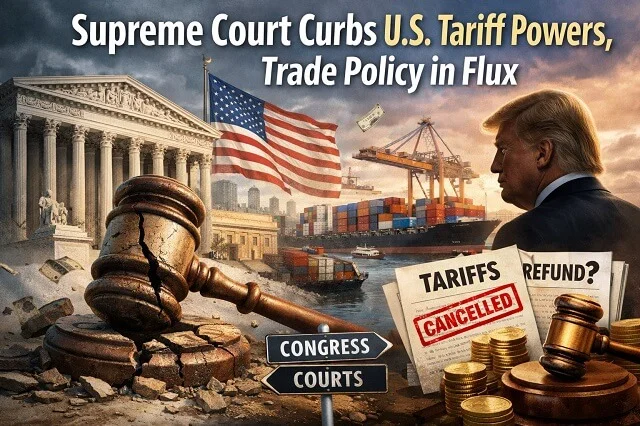
Yesterday, the Supreme Court said the quiet part out loud: the President cannot use a 1977 emergency statute as a stand-in for Congress’s taxing power. In a 6–3 decision, the Court struck down the broad tariffs imposed by the Trump administration under the International Emergency Economic Powers Act (IEEPA).
If you work in trade, this is not abstract. It changes cost, pricing, contracts, and claims. It also changes the next fight, because the Court effectively forced tariff policy back toward a lane Washington has tried to avoid for years: legislation.

The day also moved fast. Within hours of the ruling, President Trump announced a temporary replacement: a 10% global tariff under Section 122 of the Trade Act of 1974, set for 150 days.
For supply chains, the practical takeaway is simple: the fastest and broadest tariff lever the administration has been using just got removed.
So the tariff story didn’t end yesterday morning. It changed shape.
The “latest update” that changes the entire day
The White House didn’t take long to reach for a different tool. President Trump announced a new 10% global tariff under Section 122, for 150 days, on top of existing duties.
Section 122 matters because it is explicit, but it’s also temporary. The statute allows a short-term, across-the-board duty response tied to balance-of-payments concerns, and it has a hard time limit unless Congress steps in. That is the key difference from the IEEPA approach. This is not an open-ended tariff regime that can run on presidential will alone.
If you are trying to re-cost programs today, the message is not “tariffs are gone.” The message is “the basis changed, and the clock is now visible.”
Refunds are real, but they are not automatic
The money on the table is not small. Some estimates suggest that nearly $200 billion in tariff collections could be eligible for refunds after the ruling, with collections totaling about $500 million a day while the tariffs were in force.
The Court did not devise a refund program. That process gets fought out through trade litigation, Customs procedures, and timing. What matters for companies is the basic legal and operational point that Washington messaging often blurs: refunds, if available, attach to the importer of record. Consumers do not file a claim with Customs. Importers do.
This is also where a very unglamorous compliance detail becomes a big deal. CBP is now issuing refunds electronically via ACH, and as of February 6, 2026, most refund recipients must enroll through the ACE Portal to receive payment. In plain terms, if your account setup is behind, you are building a delay into your own recovery.
If you import, you should treat this like a project, not a news cycle. You need a clean duty exposure number per entry, your broker aligned, and counsel telling you what to file, when, and under what posture, based on how the trade court channels claims from here.
What Trump can do next, and what he cannot do quickly
IEEPA was the speed option. Section 122 is the short-term bridge. Beyond that, the administration still has tools, but most require process and time.
Section 301 is the obvious workhorse for country pressure, and Reuters reported the administration is also moving toward additional Section 301 investigations. The catch is that 301 is not instant. It is built around investigations, a record, hearings, and findings. That makes it slower and easier to challenge when corners get cut.
Section 232 remains available for sector-based actions framed around national security, but that is a different animal from blanket country tariffs, and it operates on its own timelines and processes.
This is the real shift businesses should internalize. The Court did not make tariffs impossible. It made “fast, broad, and indefinite” much harder to sustain.
Congress just got pulled back into the fight
Here is the point that matters more in the long term than today’s headlines. Section 122 expires unless Congress extends it. That means the next durable tariff framework is no longer something the White House can fully improvise. Congress may have to either own an extension, write new authority, or refuse both and force the administration into slower lanes.
That is not a small change for planning. Congressional action is messy, but it is legible. Hearings create signals. Draft language leaks. Votes create deadlines. Statutes create boundaries. If tariff policy shifts toward Congress, businesses get more warning, even if they do not like the outcome.
The Supreme Court basically told Washington: if you want tariffs that reshape the economy, you are going to have to debate them in the branch that taxes. Of course, the current Congress isn’t able to accomplish much these days, as the ongoing budget fights underscore.
Also Read: EU–India FTA: A Game Changer for Apparel Sourcing in Europe
What this means for textiles and apparel
Textiles and apparel sit in the bullseye of U.S. tariff policy because we import most of what we sell and because our baseline duty structure is already high. USFIA has put the average applied tariff rate for apparel at 14.6% in 2024, far higher than many other categories. They also note that over 98% of clothing sold in the U.S. is imported. That combination is why a broad extra duty layer hits this industry first and hardest.
The Supreme Court decision removes one foundation of the prior tariff structure and opens the door for importers to pursue refunds tied to the IEEPA period. But the same-day Section 122 move adds a new, temporary layer. So for apparel, the operational message is not relief. It is a recalculation.
You also cannot pretend last year did not happen. Companies moved programs, rewrote vendor terms, and restructured sourcing to survive the uncertainty. Those costs do not unwind because a court opinion changed the legal citation. The friction stays in the system, even if the rate changes.
If Congress enters this debate, textiles and apparel need to be in the room. Not with hyperbole, but with mechanics. What does a time-limited global tariff do to replenishment cycles? What does a layered duty structure do to pricing architecture? What happens when policy changes mid-season and importers are forced to choose between margin and cancellation?
Where I land
Yesterday’s ruling is a major check on presidential tariff authority. It also triggered an immediate pivot to a different statute and a temporary global duty that now carries a clear expiration date.
For companies, the right posture is boring and urgent at the same time. Re-cost what is moving. Preserve refund rights where you have exposure. Make sure your refund enrollment is operational. Then watch Congress, because the next version of U.S. tariff policy may be decided by whether lawmakers choose to extend, rewrite, or reclaim the power they just got reminded they hold.
The tariff wall did not vanish today. It lost one legal foundation, gained a temporary replacement, and moved the next argument closer to Capitol Hill. Even so, we will learn more details about how everything will unfold in the coming days and weeks. Washington has once again renewed its claim to be the “Drama Capital of the World.”