

Engineers in Switzerland have unveiled a novel fabric capable of generating strong mechanical force while remaining flexible enough to be worn like clothing, a step that could accelerate the development of wearable robotics and assistive devices that blend comfort with powerful motion. Researchers at the École Polytechnique Fédérale de Lausanne (EPFL) have published evidence that textiles woven with specially arranged shape memory alloy (SMA) fibers can deliver performance previously seen only in rigid robotic systems, overcoming a key barrier in soft robotics research.
By rethinking how metal threads are interlaced into a fabric, EPFL researchers have created a lightweight textile that contracts strongly when supplied with electrical current, producing mechanical power far greater than its own weight. The breakthrough comes from arranging ultra‑thin nickel‑titanium SMA fibers in a repeating “X‑crossing” geometry that ensures the contraction forces of each fiber are aligned in the same direction during activation. When a 4.5‑gram sample of the fabric contracts by roughly 50 %, it can lift about 1 kilogram, a feat that marks a major advance in balancing strength and flexibility for wearable assistive systems.

Most existing wearable robotic systems use rigid components such as motors and frames, limiting comfort, wearability and social acceptance for everyday use. Soft robotics aims to move away from these bulky parts, instead embedding motion into materials that can conform to the body, but delivering sufficient force and range of motion in such systems has proven difficult. Conventional textile actuators often suffer from internal force cancellation, where fibers contract in competing directions and reduce net output. The X‑crossing architecture developed at EPFL addresses this by aligning fiber intersections so that their contraction forces add constructively, avoiding the performance losses seen in earlier designs.
“This alignment ensures that the forces generated at each intersection contribute constructively, rather than working against each other, resulting in a textile actuator that significantly outperforms previous knitted or knotted designs,” said Huapeng Zhang, a doctoral student involved in the research.
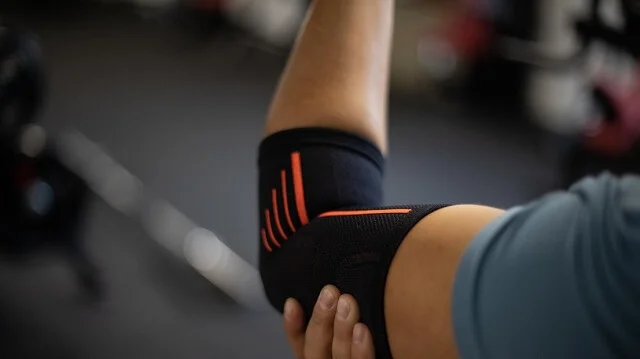
In addition to its strength, the fabric remains highly stretchable, capable of extending to about 160 % of its original length, which is critical for garments that must move with a wearer without restricting motion. To demonstrate real‑world potential, the research team integrated the textile actuators into prototypes, including a sleeve designed for elbow assistance that could lift a one‑kilogram weight through a controlled range of motion, and applications involving on‑body compression that could benefit medical sleeves and athletic wear.
Also Read: OEKO-TEX MADE IN GREEN Rated Trustworthy by Greenpeace
The researchers also developed a mechanics model to better understand and predict how the SMA fibers’ stiffness changes with temperature and stress as they undergo phase transitions. This model accounts for variations in stiffness along each fiber, enabling more accurate predictions of force and contraction under different loads and environmental conditions, which is key for designing practical wearable systems.
EPFL’s advancement arrives amid broader global research efforts into soft and wearable robotics. Other research groups are also pursuing novel actuator technologies, including automated weaving of ultra‑thin SMA coil yarns that could allow mass production of “fabric muscle” textiles capable of lifting heavier loads and powering multi‑joint assistive suits. In Korea, scientists at the Korea Institute of Machinery and Materials developed an automated weaving system enabling continuous production of SMA‑based fabric actuators that, in some designs, can lift 10–15 kilograms and assist complex movements involving the elbow, shoulder and waist.
The field of fiber‑type artificial muscles is gaining attention for its ability to emulate biological muscle functions in robotics, offering lightweight, adaptable and high‑flexibility components for next‑generation assistive devices. According to recent academic reviews, stimuli‑responsive fiber actuators are emerging as promising solutions in robotics and smart materials research, capable of delivering multiple degrees of freedom and improved performance while reducing reliance on bulky hardware.
Soft robotics, including textile actuators, fluidic systems and SMA‑based composites, is rapidly evolving toward devices that can seamlessly integrate with daily life, providing physical support without sacrificing comfort. These technologies are being explored for rehabilitation, industrial support, haptic feedback and personal mobility augmentation, potentially transforming the way humans interact with machines.
Experts say that the success of EPFL’s X‑crossing textile could be a milestone in wearable robotics, pointing toward a future in which powerful assistive garments, flexible exosuits and adaptive compression systems are not only technically viable but comfortable and socially acceptable for widespread use