
The global fashion industry doesn’t enter 2026 with a clean slate. It walks in carrying invoices from the last five years: inflation whiplash, freight chaos, interest-rate shock, and a consumer who has learned to wait for the discount code. Most forecasts point to another year of low, grinding growth rather than a clean “rebound.”
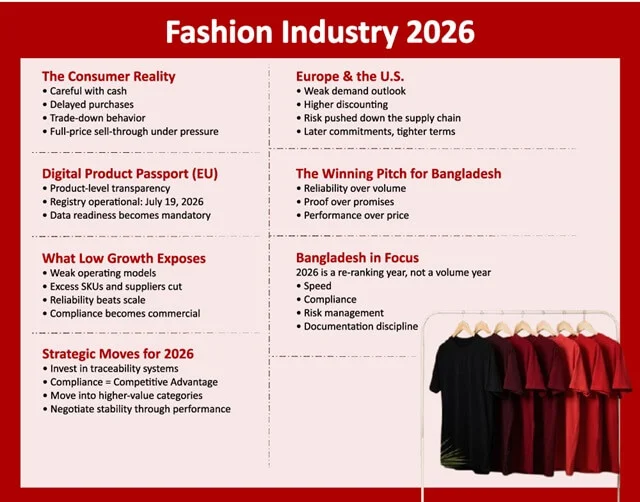
That matters because low-growth years expose weak operating models. When demand is soft, brands become ruthless about what they keep and what they cut: suppliers, SKUs, markets, even entire product categories. The conversation shifts from “How fast can you scale?” to “How predictable are you?” and “How clean is your paperwork when customs asks?”

For Bangladesh, 2026 is not a year to coast on capacity and competence. It’s a year when buyers quietly re-rank supplier countries by speed, compliance, and risk. Factories that treat documentation, traceability, and delivery performance as core production disciplines will gain share. The rest will be squeezed on price and blamed for delays.
The Consumer: Careful With Cash, Quick to Trade Down
Consumers are not done being conservative. There will be continued consumer reluctance to spend heading into 2026, driven by anxiety about the economy even as inflation has eased from earlier peaks. That “I’m okay, but I’m not confident” mindset is poison for full-price sell-through.
Europe looks similar. For instance, German business expectations going into 2026 point to weak demand and protectionism weighing on sentiment, with sectors like textiles explicitly pessimistic. In that environment, brands protect cash, cut exposure, and lean on discounting. They also push risk down the chain, which usually means later commitments and tighter terms for suppliers.
The practical result for factories is messy ordering. Smaller initial buys. More repeats if something sells, and more cancellations if it doesn’t. If you’re geared only for big, steady programs, 2026 will feel like death by a thousand cuts. If you’re built for rapid development, tight quality control, and dependable shipment windows, 2026 can still be a growth year.
Trade and Border Rules: The Friction Tax Keeps Rising
Trade policy is no longer background noise for fashion. It’s an operating cost, and it shows up as a friction tax: duties, documentation, inspections, lab testing, origin questions, and the quiet cost of inventory sitting idle because paperwork didn’t match. The industry will pay that tax in 2026 across multiple borders, not just one.
The U.S. is a major pressure point because the de minimis channel has become politically radioactive. The $800 threshold and the surge in small parcels driven by ultra-fast e-commerce have triggered a wave of reforms and enforcement focus, including executive action and growing pressure to tighten the exception. When that gate narrows, it reshapes how brands think about assortment, fulfillment, and production location.
Also Read : BGMEA Seeks Policy Support in Finance Ministry Meeting
This is not only a “Shein/Temu” story. It’s a structural shift in how trade authorities view apparel supply chains that move fast and document slowly. In 2026, brands will prefer suppliers who can prove inputs, track subcontracting, and answer customs questions without panic. Compliance won’t be a CSR department issue. It will be a commercial differentiator.
Europe: Fewer Mandates on Paper, More Demands in Practice
Europe is sending mixed signals. On one hand, the EU is moving to scale back parts of its corporate sustainability reporting and due diligence rules, raising thresholds and reducing the number of companies directly covered, with formal steps continuing into early 2026. That sounds like relief and will reduce reporting burdens for some firms.
On the other hand, market expectations don’t disappear just because thresholds change. Large brands, major retailers, banks, and insurers will still request supplier data because they face reputational risk and legal exposure even when rules soften at the edges. The EU’s direction remains toward product-level transparency, and it is building the infrastructure to make that normal.
The Digital Product Passport is the clearest signal. Under the EU’s Ecodesign for Sustainable Products framework, the DPP is a core tool for sustainability and compliance, and the registry is expected to be operational by 19 July 2026. Even if apparel timelines vary by delegated acts, 2026 is when brands and suppliers will treat “data readiness” as a real deadline, not a PowerPoint concept.
Carbon and Cost: 2026 Is When Accounting Gets Real
Carbon is moving from narrative to accounting. The EU’s Carbon Border Adjustment Mechanism enters its definitive regime in 2026, with the transitional phase ending in 2025 and the definitive period beginning on January 1, 2026. Apparel isn’t the headline category today, but CBAM is training the market to think in terms of embedded emissions and border pricing.
That shift matters for Bangladesh because fashion’s true emissions sit upstream: energy use at mills, boiler operations at dyehouses, chemical use, wastewater treatment, and the freight patterns that tie it all together. In 2026, brands will continue sorting suppliers by operational reality, not marketing language. “We care about sustainability” won’t count if energy data is missing, subcontractors are invisible, or chemical management is vague.
The companies that win will be those that can speak in numbers without sounding defensive. What is your energy mix? What is your process efficiency? Can you document wastewater handling and chemical controls? Can you show continuous improvement across seasons, not just one-off audits? In a tight market, hard data helps protect margins by reducing potential risk.
Will 2026 Be A Year Of Opportunity For Bangladesh?
According to the UN, Bangladesh will graduate from Least Developed Country status in November. Graduation is not a single-day shock to every order, but it is a clear signal for buyers planning their medium-term sourcing map. Preference erosion is a forward-looking issue, and procurement teams will spend 2026 building options.
That doesn’t mean Bangladesh loses. It means Bangladesh has to sell more than labor and capacity. The winning pitch in 2026 is reliability and proof: tighter lead times, fewer quality surprises, stronger product development, and clean chain-of-custody discipline. The factories that can deliver on time and produce credible documentation will become strategic partners, not interchangeable vendors.
The smart move for 2026 is to treat the coming trade and compliance shift as a productivity program. Invest in systems that make traceability routine, not heroic. Push deeper into higher-value categories where execution matters and price pressure is less severe. And negotiate with buyers from a position of performance: if you can ship, prove, and improve, you can demand stability in return. Bangladesh built a world-class export engine once; 2026 is the year to upgrade it for a world that wants receipts.

Robert Antoshak, Vice President of Global Strategic Sourcing & Development at Grey Matter Concepts, brings over 30 years of experience in the textile and apparel sector. He has advised governments, led consulting projects worldwide, and written extensively on global trade, sustainability, and sourcing. Previously a Partner at Gherzi Textil Organisation, he continues to shape industry perspectives through his articles and thought leadership.
Antoshak is a regular contributor to just-style.com and sourcingjournal.com.